With the rapid development of science and technology, the field of humanoid robots is becoming a new track for major technology companies to compete. On February 25, 2025, He Xiaopeng, chairman and CEO of Xpeng Motors, said at the overseas delivery ceremony of Xpeng X9 that Xpeng Motors is confident that it will become one of the first companies in China to mass-produce L3 robots. This declaration not only shows He Xiaopeng's ambitions, but also demonstrates Xpeng's deep foundation in the field of humanoid robots.
1. Technical advantages: reuse and innovation of intelligent driving technology
Xpeng's technology accumulation in the field of intelligent driving has provided a solid foundation for its humanoid robot project. He Xiaopeng revealed that this year, Xiaopeng Motors will achieve quasi-L3 and L3 capabilities for intelligent driving. This means that Xpeng's intelligent driving system will have a high level of automation and intelligence, and will be able to make autonomous decisions and drive in complex road conditions. These technologies will be fully applied to Xpeng's humanoid robot, Iron, to make it more capable of perception, decision-making, and control.
Xpeng's world model, reinforcement learning, and distillation capabilities will also be reused in humanoid robots. World model technology can allow robots to better understand the surrounding environment and build high-precision 3D models. Reinforcement learning technology enables robots to learn and optimize behavioral strategies through continuous trial and error. The distillation capability technology can transform complex model knowledge into a more concise and efficient knowledge representation, which is convenient for robots to learn and apply quickly. The reuse of these technologies can not only accelerate the research and development process of humanoid robots, but also improve their performance and intelligence.
2. Product progress: technical parameters and application scenarios of Iron robots
Xpeng Motors has launched two generations of humanoid robots, of which the Xpeng AI robot Iron, which was launched at the end of last year, adopts a humanoid structure design, with a height of 178cm, a weight of 70kg, and 62 active degrees of freedom. The Iron robot is equipped with Xpeng's self-developed Turing AI chip, with a computing power of 3,000T, and is equipped with an AI Eagle Vision System and Dimensity AIOS, which supports end-to-end large models and reinforcement learning. These technologies enable Iron robots to have powerful perception, decision-making, and motion control capabilities that enable them to autonomously complete a variety of tasks in complex environments.
Iron robots have already entered Xpeng's factories, where some of the components of the Xpeng P7+ are assembled. This shows that the Iron robot has a certain application ability in the actual production scenario, and can take on some repetitive and dangerous work, which improves production efficiency and quality. In addition, Xpeng plans to open factory tours in 2025 to further demonstrate the practical effects of the Iron robot.
3. Industry status: the layout and advantages of Xpeng Motors in the field of humanoid robots
Xpeng's layout in the field of humanoid robots can be traced back to 2020, when Xpeng acquired a quadruped robot company to establish Pengxing Intelligence, which was later integrated into an internal business unit. In 2021, Xpeng released its first intelligent robot horse, which has made breakthroughs in power modules, motion control, and intelligent interaction. In 2023, Xpeng launched the first bipedal humanoid robot PX5, which is 178 cm tall, weighs 70 kg, has 62 degrees of freedom, and uses Turing AI chips for the first time, equipped with end-to-end large models and Tianji AIOS, with independent thinking and reasoning capabilities. In November 2024, Xpeng launched its AI robot, Iron. These layouts and product launches show that Xpeng Motors has a certain amount of technology accumulation and market competitiveness in the field of humanoid robots.
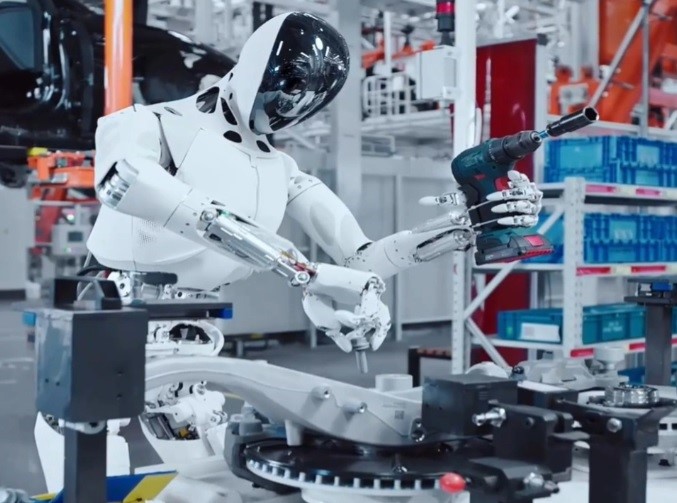 Pictured: Xpeng Iron has entered the Xpeng Motors plant
Xpeng's advantage also lies in its technology accumulation and data resources in the field of intelligent driving. Intelligent driving and humanoid robots are highly homologous in perception, planning and control technology, and components such as cameras and lidars can be reused. This enables Xpeng Motors to quickly enter the field of humanoid robots with the accumulation of existing technologies, and accelerate the technological progress and product iteration of humanoid robots through data sharing and collaborative optimization.
4.Market prospects: the trillion-level market of humanoid robots and the opportunities of Xpeng Motors
Humanoid robots are positioned as "expected to become disruptive products after computers, smartphones, and new energy vehicles", and will have a profound impact on social and industrial changes and the global competition pattern. According to market research institutions, the global humanoid robot market will reach the trillion dollars level by 2030. The huge potential of this market has attracted the attention and investment of many technology companies and car manufacturers.
Xpeng's active exploration in the field of humanoid robots is the epitome of this trend. With the continuous progress of technology and the reduction of costs, humanoid robots are expected to be widely used in many fields such as home services, education, medical care, and elderly care. With its technological advantages and product layout in the field of intelligent driving and humanoid robots, Xpeng Motors is expected to occupy a place in this market and bring new growth opportunities to the company.
5. Challenges and prospects: Challenges and future prospects of Xpeng Motors on the road to mass production of L3 robots
Although Xpeng Motors has made certain technical progress and product application achievements in the field of humanoid robots, moving from the L2 stage to the L3 stage will be a leap of dozens of times more capabilities and difficulties. Level 3 robots need to have higher autonomy and decision-making capabilities in complex environments, and be able to cope with various unexpected situations and complex tasks. This not only requires more powerful hardware performance and software algorithm support, but also requires a large amount of data accumulation and optimization.
In terms of hardware, L3 robots require more powerful chip computing power, more accurate sensors and more efficient drive systems. Xpeng Motors has already adopted its self-developed Turing AI chip on the Iron robot, but in order to meet the needs of the L3 level, it needs to further improve the computing power and energy efficiency ratio of the chip. In addition, the accuracy and reliability of sensors need to be continuously improved to ensure the robot's ability to perceive in complex environments.
In terms of software algorithms, L3 robots require more complex decision-making algorithms and more efficient learning capabilities. Technologies such as Xpeng's world model, reinforcement learning, and distillation capabilities provide robots with powerful learning and decision-making capabilities, but these algorithms need to be continuously optimized and improved in order to cope with more complex tasks and environments. At the same time, robots also need to have stronger self-learning capabilities and be able to optimize and improve themselves in continuous practice.
In terms of data accumulation, L3 robots need a large amount of data to train and optimize algorithms. Xpeng Motors has accumulated a large amount of data in the field of intelligent driving, which can provide strong support for the training of humanoid robots. However, in order to meet the needs of the L3 level, the scale and diversity of data needs to be further expanded, including data for different environments, different tasks, and different users.
Looking to the future, although Xpeng Motors faces many challenges on the road to mass production of L3 robots, it also has huge opportunities. With the continuous progress of technology and the gradual maturity of the market, humanoid robots are expected to become an important role in life and production in the future. With its technological advantages and market layout in the field of intelligent driving and humanoid robots, Xpeng Motors is expected to take a leading position in this field, bringing new growth points and competitiveness to the company.
In short, He Xiaopeng's ambition and Xiaopeng Motors' technology accumulation have injected new vitality into the development of the field of humanoid robots. We expect Xpeng Motors to make greater breakthroughs on the road to mass production of L3 robots and make greater contributions to the development of human society."